Cognitive Offloading to AI: What to Keep in Your Head
/ 7 min read / by Nobita Huang
Cognitive offloading is using something outside your head to reduce the mental work a task takes. A shopping list is cognitive offloading. So is asking an AI tool to summarise a log file.
The difference with AI is that it does more than hold what you give it. It chooses what matters, fills gaps, and proposes answers. That makes it useful, and it also makes it easy to hand over a decision without noticing.
Key points
- Offloading is normal and often sensible. It causes trouble when you hand over something you still need to understand.
- In a survey of 319 knowledge workers, higher confidence in AI went with less reported critical thinking (Lee et al., 2025).
- In an experiment with nearly 1,000 high school students, those who practised with a standard AI chat tool scored 17% lower on a later exam without AI. A tutor version built to protect learning largely removed that drop (Bastani et al., 2025).
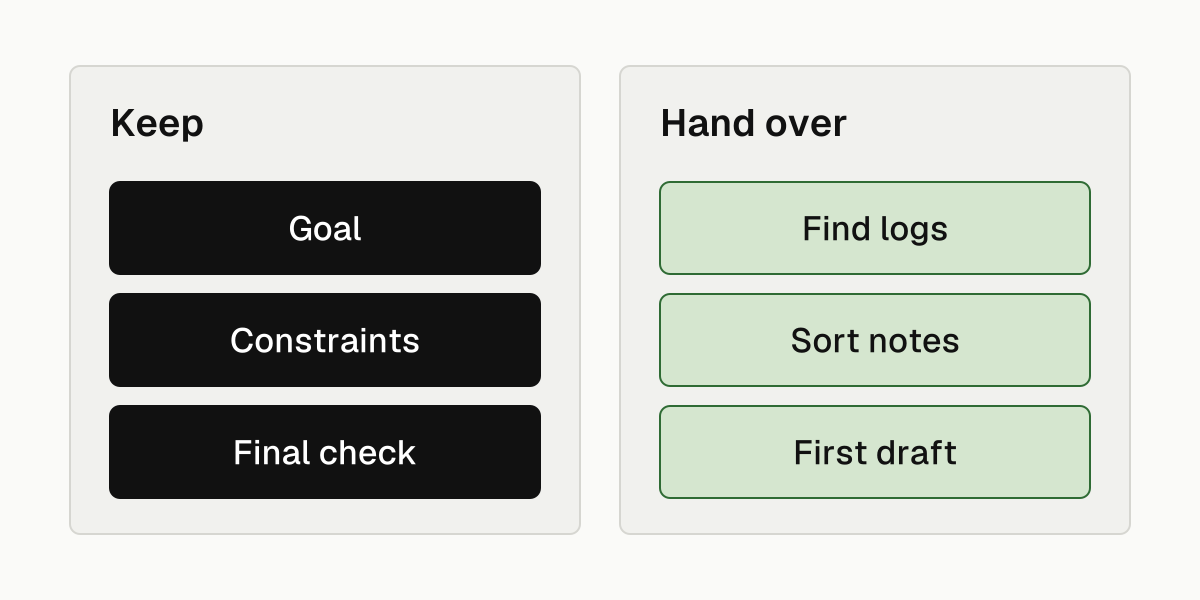
- A practical rule: hand over searching, sorting, and first drafts. Keep the goal, the constraints, and the final check.
What is cognitive offloading?
Evan Risko and Sam Gilbert describe cognitive offloading in their 2016 review as using physical action to change what a task demands of your mind, so that it takes less mental effort. Writing a phone number down counts. So does tilting your head to read rotated text.
Their review also makes a point that matters for AI: people offload when they believe it is more efficient than doing the work in their heads, and that belief is not always correct.
Engineers do this all day. You keep a system's constraints in mind while a tool searches the logs. The tool handles the search, and you keep your attention for the decision.

How is offloading to AI different?
A notebook stores what you write. A language model decides what to include, suggests a cause, and writes a solution. Those are decisions, and they arrive looking finished.
Say you ask for a summary of an incident. The summary may leave out one unusual log entry. A proposed fix may assume that a callback arrives only once, and the test that comes with it may repeat the same assumption. Everything reads well, and the question is still open.
So write the task down before you hand it over:
- Goal: what result do I need?
- Constraints: what must stay true?
- Evidence: what would show that the result is correct?
For a payment callback, the goal might be to record a successful payment. The constraint is that a provider retry must not create a second record. The evidence is a test that sends the same event twice.
This gives the AI a better brief. It also gives you something concrete to check the answer against.
Does using AI reduce critical thinking?
The research so far shows a link. It does not show that AI causes a lasting loss of ability.
Lee and colleagues (2025) surveyed 319 knowledge workers, who shared 936 examples of using generative AI at work. People with more confidence in AI reported less critical thinking. People with more confidence in their own ability reported more.
The thinking also moved. Less went into producing the work, and more went into checking it and fitting it together. These are people's own reports, not measurements of their thinking.
Gerlich (2025) studied 666 people and found a negative correlation between frequent AI use and critical thinking scores, with cognitive offloading as a link between the two. Younger participants used AI more and scored lower. The author is clear that this shows correlation, not cause.
What I take from both: checking is now a larger part of the job, so it needs to be a real step in the work.

"Looks reasonable" is a weak check. These are stronger ones:
- Compare a summary with the original source.
- Run a proposed fix against the reported failure.
- Add a case that could prove the explanation wrong.
- Read the documentation for any dependency that matters.
AI can help you write these checks. You still decide whether they test the right thing.
Does using AI hurt learning?
It can, and the design of the tool makes a large difference. A clear example is a 2025 field experiment by Bastani and colleagues with nearly 1,000 high school maths students in Turkey. One group practised with a standard chat interface (GPT Base). Another used a tutor with safeguards for learning (GPT Tutor). A third group had no AI.
| Compared with the no-AI group | During practice, with AI | Later exam, without AI |
|---|---|---|
| GPT Base | 48% better | 17% worse |
| GPT Tutor | 127% better | About the same |
Practice scores went up in both AI groups, but only GPT Base students did worse once the tool was gone. A good result with AI did not mean the skill had been learned.
This was one maths setting, so it does not predict what happens to every engineer using every tool. It is still a good reason to ask what you want from a session: a finished task, or a skill you keep.
When learning is the goal, ask for a hint, an example, or feedback on your attempt. Then do the last step yourself.

With a new API, that could mean reading the explanation, closing it, and writing a small example from memory. Then change one requirement. Can you say what has to change, and why?
You do not need to memorise every method name. You do need enough understanding to notice when an answer is wrong.
What should you hand over to AI, and what should you keep?
| Hand over | Keep |
|---|---|
| Searching logs and documents | The goal, and why it matters |
| Sorting and summarising notes | The constraints that must hold |
| First drafts and boilerplate | Deciding what counts as evidence |
| Listing possible causes | Accepting or rejecting the result |
| Writing tests you then review | Anything you are trying to learn |
One question settles most cases: would I need to understand this to notice that it is wrong? If yes, keep a hand on it.
An example you can try
Pick one task where you can inspect the result yourself. For a duplicate payment callback, the brief could be:
Goal: find why one payment event creates two records.
Constraint: the provider can send the same event more than once.
First, list possible causes and the evidence that would tell them apart. Mark your assumptions. Do not propose a code change until we have the evidence.
Then work through the answer:
- Pick one cause to investigate.
- Look for the evidence in the real system.
- Check whether the explanation survives a duplicate-event test.
- Explain the fix in your own words.
If you are learning the concept as well, add one more step: put the answer away and solve a related example.
Frequently asked questions
Is cognitive offloading bad?
No. Offloading is a normal way to free up attention, and notes, calendars, and search tools all rely on it. The risk comes from handing over work you still need to understand or check.
Does AI make you worse at critical thinking?
It has not been proven. Surveys link heavy use of AI and high trust in AI to less critical thinking, but they cannot show that AI is the cause. Checking AI output is itself critical thinking, and it takes effort.
How can you use AI without losing your skills?
Keep the goal, the constraints, and the final check for yourself. When you want to learn something, ask for hints or feedback in place of full answers, then try a related task without help.
Sources
- Risko, E. F., and Gilbert, S. J. (2016). Cognitive Offloading. Trends in Cognitive Sciences, 20(9), 676-688. A review.
- Lee, H.-P., and colleagues (2025). The Impact of Generative AI on Critical Thinking. CHI 2025. A survey of 319 knowledge workers.
- Gerlich, M. (2025). AI Tools in Society: Impacts on Cognitive Offloading and the Future of Critical Thinking. Societies, 15(1), 6. Surveys and interviews with 666 participants.
- Bastani, H., and colleagues (2025). Generative AI without guardrails can harm learning: Evidence from high school mathematics. PNAS, 122(26). A randomised field experiment.